Linear Motion Calculator
These calculators are used to calculate linear motion. If you need to calculate limited angle rotary motion, please use the rotary motion calculators.
Unit Converter
| Conversion Type | From Value | From Units | To Value | To Units |
|---|---|---|---|---|
Newton’s Second Law:
Force = Mass × Acceleration
To size a stage properly the force must be known. If force is not known it must be calculated from this equation. The mass is the total mass of the customer payload plus the mass of the moving components of the stage. If the acceleration component is not known it must be calculated. Calculators are provided under the Acceleration tab for estimating the acceleration of a system. Once the force is determined, the duty cycle for all of the specific forces must be determined to calculate the RMS force, which is the average required force. The Force RMS tab provides the tools needed to determine the RMS Force of a motion profile.
| Variable | Description | Units | Calculation |
|---|---|---|---|
| m | Moving mass | ||
| a | Acceleration | ||
| F | Force | 0 |
*accelerations up to 10 g’s are possible under closed loop control
*accelerations up to 20 g’s are possible under open loop control
- Triangular Acceleration
- Trapezoidal Acceleration
- Sinusoidal Acceleration
- Force RMS
- Duty Cycle
- Force At Duty Cycle
Triangular Acceleration Profile
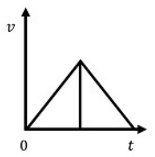
| Variable | Description | Units | Calculation |
|---|---|---|---|
| d | Distance moved | ||
| t | Time to complete move | (sec) | |
| G | Gravitational constant | (in/s²) | 386 |
| a | Acceleration | (g) | 0 |
Trapezoidal Acceleration Profile
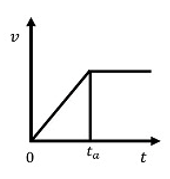
Known Variables
| Variable | Description | Units | Calculation |
|---|---|---|---|
| d | Distance moved | ||
| t | Time to complete move | (sec) | |
| v | Velocity | ||
| G | Gravitational constant | (in/s²) | 386 |
| a | Acceleration | (g) | 0 |
Sinusoidal Acceleration Profile
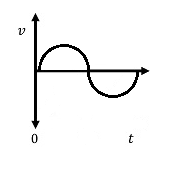
Known Variables
| Variable | Description | Units | Calculation |
|---|---|---|---|
| D | Distance moved | ||
| f | Frequency | (Hz) | |
| V | Velocity | ||
| G | Gravitational constant | (in/s²) | 386 |
| a | Acceleration | (g) | 0 |
Force RMS Calculation
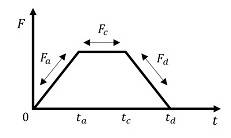
| Variable | Description | Units | Calculation |
|---|---|---|---|
| Fa | Acceleration Force | ||
| Fc | Constant Velocity Force | ||
| Fd | Deceleration Force | ||
| ta | Time to accelerate | (sec) | |
| tc | Time at constant velocity | (sec) | |
| td | Time to decelerate | (sec) | |
| toff | Dwell time | (sec) | |
| ton | ta + tc + td | (sec) | |
| FRMS | Average required force | 0 |
Duty Cycle Calculation
| Variable | Description | Units | Calculation |
|---|---|---|---|
| ton | Time with power applied | (sec) | |
| toff | Dwell time | (sec) | |
| Duty Cycle | Percentage of total time spent active | % | 0 |
| Example |
|---|
| Duty Cycle = 1 sec on, 3 sec off |
| Duty Cycle = 1/(1+3) = 1/4 |
| Duty Cycle = 25% |
Note: Duty Cycle is only for DC motors.
Force at Duty Cycle
| Variable | Calculation |
|---|---|
| Duty Cycle | |
| Force at Duty Cycle | |
| Force at 100% | 0 |
Example (DC Motors):
Force at 10% Duty Cycle = 1 lb × (1/10%)^1/2
Force at 10% Duty Cycle = 1 lb × 3.16 = 3.16 lbs
Note: This calculation is only for DC motors.
Use the following formula for AC motors:
AC Duty Cycle Calculations:
- Force @ 50% = Force @ 100% × 1.75
- Force @ 15% = Force @ 100% × 5
- Force @ 3% = Force @ 100% × 8