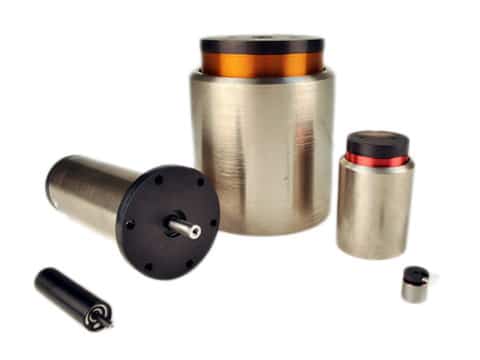
Voice Coil Actuators
Voice Coil Actuators
Overview
Voice coil actuators are precision linear motors designed for short-stroke applications (typically under 2 inches), delivering high acceleration and exceptional position control in compact packages. These non-commutated DC motors operate on the Lorentz force principle, providing direct, linear force proportional to input current without requiring complex commutation electronics.
The system consists of a permanent magnetic field assembly and a coil assembly. When paired with a bearing system, position feedback device, servo amplifier, and motion controller, voice coil actuators enable precise position, velocity, acceleration, and force control in applications where space is limited and performance is critical.
How Voice Coil Actuators Work
Voice coil actuators operate on the Lorentz force equation: F = B × I, where force (F) is the product of magnetic flux density (B) and current (I). When current flows through a conductor placed in a magnetic field, force is exerted perpendicular to both the current direction and magnetic field.
The permanent magnet assembly creates a fixed magnetic field. Input current direction determines linear displacement direction, while current magnitude controls force output. This simple relationship eliminates the need for commutation, resulting in smoother motion and simpler control systems.
Force remains relatively constant throughout the actuator’s stroke, with minor decreases at stroke extremes. Either the coil assembly or magnetic assembly can serve as the moving element, providing design flexibility.
Key Configurations
Moving Coil (NCC Type)
Moving coil actuators feature a coil wound around a bobbin that moves through a stationary magnetic field assembly. These actuators are typically larger in diameter but shorter in length.
Characteristics:
- Generally supplied without bearings or shaft (can be added)
- Higher forces achieved by increasing diameter
- Large radial clearances available for tilt or radial movement applications
- Moving leads required during operation
Typical Structure: Coil assembly moves in and out of a steel housing containing a concentric permanent magnet assembly.
Moving Magnet (NCM Type)
Moving magnet actuators have a stationary coil with the magnetic assembly mounted to a moving shaft. These actuators are typically smaller in diameter but longer in length.
Characteristics:
- Supplied with integrated bearings and shaft
- Higher forces achieved by increasing pole count (length) or diameter
- No moving leads—coil assembly remains stationary
- Optional no-power magnetic latching at one or both stroke ends
Typical Structure: Permanent magnet “piston” moves through a cylindrical coil tube with end caps containing bearing systems.
Performance Specifications
Standard Specifications:
- Stroke: 0 – 3 inches [0 – 75 mm]
- Continuous Force: Up to 100 lbs [450 N]
- Peak Force: Up to 300 lbs [1350 N]
- Acceleration: Up to 20 g’s
- Position Resolution: Down to 0.1 microns (with linear encoder or LVDT)
Extended Capability:
- Longer strokes available (efficiency/motor constant decreases proportionally)
- Multiphase coil winding enables commutation for extended stroke efficiency
- Custom designs accommodate specific force, stroke, and acceleration requirements
Motor Constant & Efficiency
The motor constant (Km) represents the actuator’s efficiency in converting electrical power to mechanical force. For non-commutated voice coil actuators, motor constant is inversely proportional to stroke length—longer strokes result in lower efficiency.
Optimizing Extended Stroke Performance: For applications requiring longer strokes with maintained efficiency, the coil assembly can be wound as a multiphase coil. This requires commutation but preserves motor constant across the extended range.
Force Characteristics
Voice coil actuators exhibit linear force-to-current characteristics throughout their operational range. The relationship between force output and position remains relatively constant across the stroke, with predictable force reductions only at extreme stroke ends.
Force Control Advantage: The direct proportionality between current and force enables precise force control applications. By monitoring and adjusting input current, systems can achieve accurate force output independent of position.
Advantages & Limitations
| Advantages | Limitations |
|---|---|
| Compact Design – High force-to-weight ratio | Short Stroke – Standard designs limited to ~3 inches |
| High Acceleration – Up to 20 g’s with light payloads | Stroke-Efficiency Trade-off – Motor constant decreases with longer strokes |
| No Commutation – Simpler electronics and control | Moving Leads – NCC type requires lead management |
| Zero Cogging – Smooth, consistent force output | Power Consumption – Continuous power required for force generation |
| Precision Control – Sub-micron positioning capability | Heat Management – Continuous operation requires thermal consideration |
| Fast Response – Low electrical and mechanical time constants | |
| Linear Force Output – Precise force control capability | |
| Custom Flexibility – Rapid turnaround on custom designs | |
| High Flux Density – Neodymium magnets maximize performance |
Control Options
Open Loop Operation:
- Function generator provides frequency and amplitude control
- Suitable for oscillatory applications
- Requires spring system for centering and energy conservation
Closed Loop Operation:
- Linear servo amplifier drives voice coil based on position feedback
- Motion controller provides trajectory planning and error correction
- Position feedback from linear encoder or LVDT
- Enables precise position, velocity, and acceleration profiles
Force Control:
- Current monitoring enables direct force control
- Linear force-to-current relationship simplifies control algorithms
- Suitable for applications requiring variable force output
Design Customizations
Voice coil actuators can be customized for specific application requirements:
- Large radial clearances for limited rotation applications
- Vacuum-compatible materials using low-outgassing components
- Integrated feedback devices for closed-loop positioning
- Magnetic latching for holding position without power (NCM type)
- Custom geometries to fit confined spaces
- Multiphase windings for extended stroke efficiency
Applications
Voice coil actuators excel in precision short-stroke applications requiring high acceleration and rapid response:
Industrial Automation:
- Pick and place equipment (Z-axis positioning)
- Inspection systems and alignment stages
- Valve actuation and flow control
- Precision dispensing and metering
Medical & Scientific:
- Medical diagnostic probes
- Laser beam steering and scanning
- Autofocus mechanisms
- Optical positioning systems
Optical Systems:
- Mirror tilt and focus actuators
- Camera lens positioning
- Beam steering and stabilization
- Optical switch actuation
Test & Measurement:
- Probe positioning
- Material testing actuators
- Vibration testing equipment
- Precision measurement systems
Why Choose Voice Coil Actuators
Voice coil actuators are ideal for short-stroke precision applications requiring high acceleration and fast response times. The simple non-commutated design eliminates cogging and enables sub-micron positioning when paired with appropriate feedback systems. Compact packaging fits into space-constrained applications, while the linear force-to-current relationship simplifies both position and force control. Both moving coil (NCC) and moving magnet (NCM) configurations provide design flexibility, with custom options including vacuum compatibility, integrated feedback, and magnetic latching.
Ordering Information
Voice coil actuators are available in standard NCC (moving coil) and NCM (moving magnet) configurations. Custom designs accommodate specific force, stroke, acceleration, and integration requirements. Typical lead time for custom designs is shorter than conventional motor types due to simplified construction.
Required Electronics: Linear servo amplifier and motion controller (for closed-loop operation) or function generator (for open-loop oscillation).
Customer-Supplied Components: Bearing system (if not integrated), position feedback device (for closed-loop control), mounting hardware.
Products
| Product Number | Device Type | Stroke Length | Bearing Type | Continuous Force (100% Duty) | Peak Force (10% Duty) | Outside Diameter | Housing Length | |
|---|---|---|---|---|---|---|---|---|
|
NCC01-04-001-1X | Moving Coil mm | 0.13 in / 3.2 mm | None Provided | 0.06 lbs / 0.27 N | 0.18 lbs / 0.80 N | 0.44 in / 11.1 mm | 0.36 in / 9.0 mm |
|
NCC01-07-001-1R | Moving Coil mm | 0.12 in / 3.0 mm | None Provided | 0.15 lbs / 0.67 N | 0.45 lbs / 2.0 N | 0.69 in / 17.5 mm | 0.48 in / 12.2 mm |